

.webp?length=400&name=Cyber-Radio-NDR585%20(3).webp)

.webp?width=70&height=70&name=Vector%20(1).webp)


-
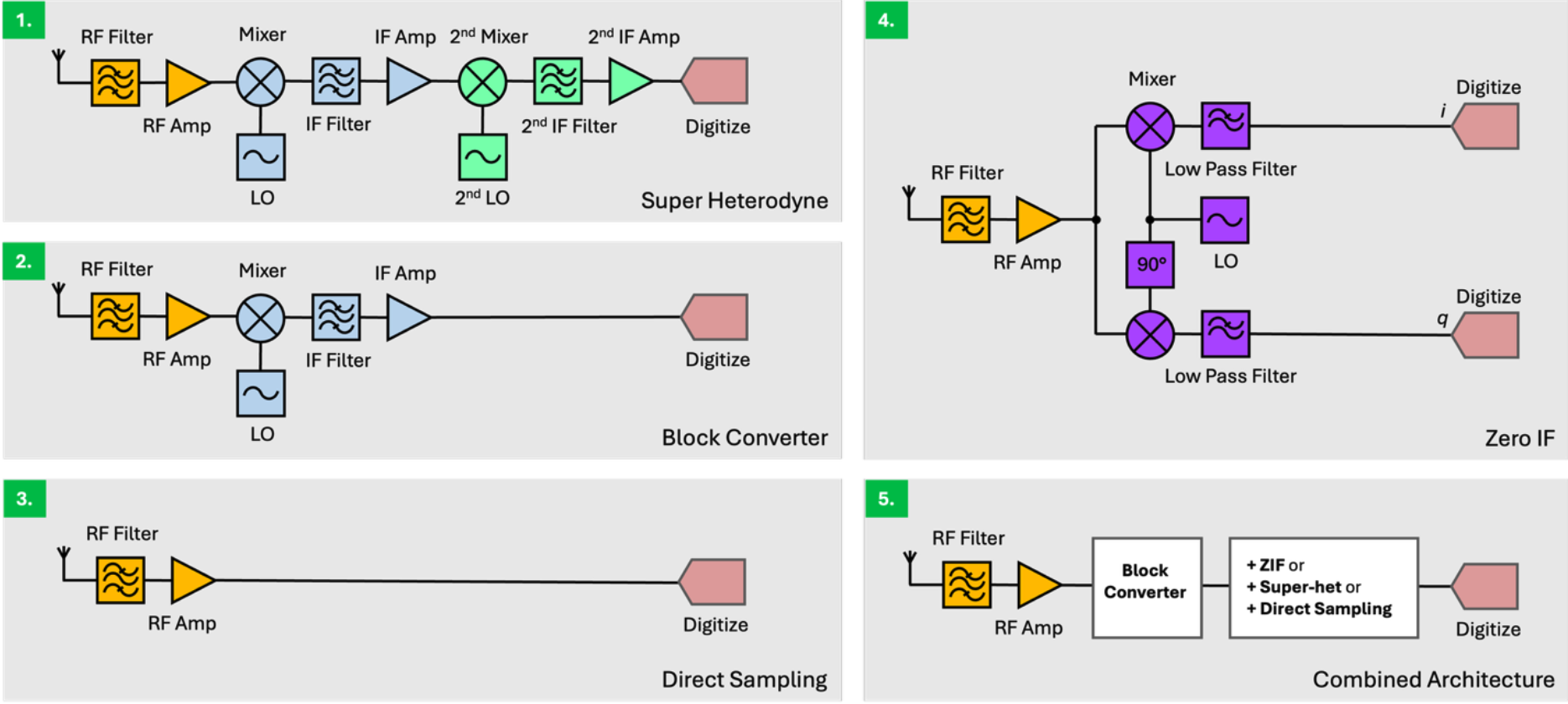
Different SDR architectures (superheterodyne, direct conversion, direct sampling) each balance trade-offs between complexity, cost, and performance.
-
Direct sampling is emerging as the go-to for flexibility and scalability as ADC technology advances.
-
The right architecture depends on mission priorities — bandwidth, frequency agility, and SWaP constraints — not just specs on paper.
10/30/25
Software Defined Radios (SDRs) are transforming industries with their flexibility, agility, and upgradeability—but choosing the right RF architecture is critical. This article explores five common SDR architectures—Superheterodyne, Block Converters, Direct Sampling, Zero IF, and hybrid combinations—breaking down their strengths, trade-offs, and future potential. From the high-performance customization of Superhets to the low-SWaP efficiency of Zero IF and the
rapid evolution of Direct Sampling, each approach offers unique advantages depending on mission needs. With comparisons of form (size, weight, power, reconfigurability) and function (coverage, bandwidth, performance, selectivity), this guide helps engineers and decision-makers match architectures to real-world applications.